Coin Flips and Chance
About this lesson, for parents and teachers
Nobody can predict one coin flip. But can you predict a thousand? Flip, roll and watch what happens when chance happens over and over again.
Ages 9–11 · about 6 minutes · builds on Count the Lights · leads to How Chatbots Pick the Next Word
Try this
- Press Flip 10. Did you get exactly 5 heads?
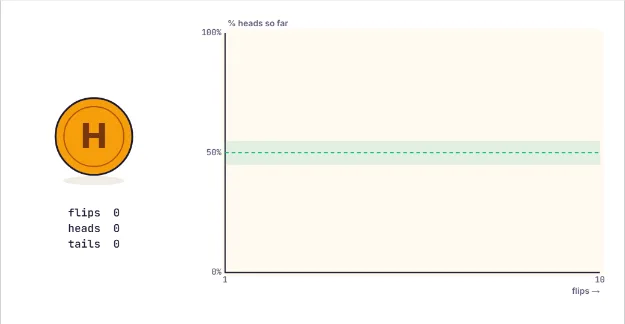
- Keep flipping until you pass 1000 flips. Watch the heads line settle down.
- Switch to two dice: tap the total you think will come up most, then roll 1000 times.
- Count how many ways two dice can make 7.
How it works
A fair coin has a probability of 1 in 2 (50%) of landing heads. That does not mean 10 flips give exactly 5 heads. With only a few flips you might get 3 or 7. Each flip is random and does not remember the ones before it. Even 5 heads in a row does not make tails "due" next time. The coin has no memory.
But as you flip more and more, the percentage of heads gets closer and closer to 50%. After 1000 flips it is usually between 47% and 53%. This is called the law of large numbers: one event is unpredictable, but the average of many events is very predictable. The wobbles never disappear completely, but they get smaller and smaller compared with the total.
Two dice are more interesting. There are 6 × 6 = 36 ways they can land. Only one way makes 2 (1 + 1), but six ways make 7 (1 + 6, 2 + 5, 3 + 4, 4 + 3, 5 + 2, 6 + 1). So 7 should come up about 6 times in every 36 rolls, and 2 only once. Roll enough and the bars grow into a triangle, the distribution of the sums.
The computer in this lesson uses a random number generator to flip and roll, thousands of times a second. Running many random trials to see the pattern is called a simulation. Scientists use simulations to predict weather, test bridges and design games that feel fair. Because each run is random, your results will be a little different from a friend's, but the shapes will match.
Where engineers use this
Weather forecasters, insurance companies and game designers all use probability and simulations. Board game designers use the dice triangle on purpose: in Catan, tiles numbered 6 and 8 pay out far more often than 2 or 12.
Words to know
- Probability
- How likely something is, from 0 (impossible) to 1 (certain). A fair coin landing heads is 1/2.
- Random
- Impossible to predict exactly, like a single coin flip.
- Law of large numbers
- The more times you repeat a random event, the closer the average gets to the true probability.
- Distribution
- The shape you get when you count how often each result happens.
Talk about it
Goal: Flip thousands of virtual coins and dice and watch randomness turn into a predictable shape.
- If you flipped 5 heads in a row, is tails more likely next time? Why or why not?
- Why does 7 come up more than 12 when you roll two dice?
- Where have you seen chance used in a game you play?
Without a screen: Flip a real coin 20 times and tally heads, then combine tallies from everyone in the family. Is the family total closer to half? Then roll two dice 50 times and draw a bar chart of the totals on paper. Does it start to look like a triangle?
Curriculum links: Common Core 7.SP.C.6 and 7.SP.C.7 (approximate and develop probability models; this lesson previews them for younger learners) and 5.MD.B.2 (line plots of data); CSTA K-12 1B-DA-07 (use data to make predictions)
Questions
What is the law of large numbers for kids?
It means that if you repeat something random many times, the results average out to what you expect. One coin flip is a surprise, but 1000 flips land very close to half heads.
Why is 7 the most common roll with two dice?
There are more ways to make 7 than any other total: six of the 36 possible pairs add up to 7. Totals like 2 and 12 only have one way each, so they are rare.
How do computers make random numbers?
Most use a random number generator: a formula that produces numbers that look random and pass statistical tests. For things like security, computers also mix in unpredictable physical noise.