Count the Lights
About this lesson, for parents and teachers
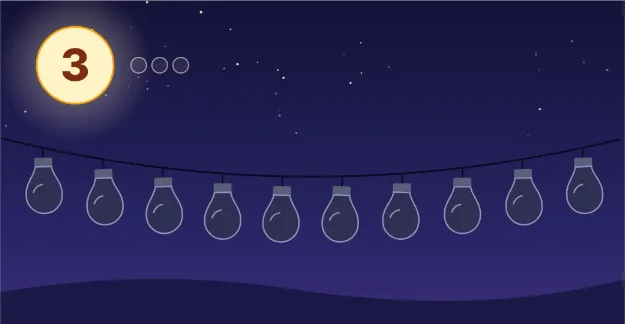
It is night time and the fairy lights are all dark. Can you light them up, one for each number?
Ages 3–5 · about 4 minutes · leads to Light On, Light Off, Coin Flips and Chance
Try this
- Look at the moon. It shows how many lights to turn on, with little dots underneath.
- Tap one dark bulb. It lights up and the voice says the number.
- Keep tapping dark bulbs until every dot by the moon is full. Try 3, 5, 7 and then 10.
- Tap a bulb that is already on and it wiggles: each light is counted only once.
How it works
When we count, we say one number for each thing. Not two numbers for one bulb, and no skipping. Grown-ups call this one-to-one correspondence. In this game every tap lights exactly one new bulb and says exactly one new number, so your child feels the match between the word and the thing with their own finger.
The last number we say tells us how many there are. If we count one, two, three, four, five, then there are five lights, even if we counted them in a different order. The dots next to the moon fill up as we go, so a child can see when the group is complete without needing to read the numeral.
Computers count in a very similar way. A computer keeps a number called a counter. Each time something happens, like a tap or a new message, it adds one to the counter. It never counts the same thing twice. That is why the game will not let you count a bulb that is already shining. Careful counting is one of the very first ideas in computing.
Where engineers use this
Apps count all the time: a step counter adds one for every step you take, and a game adds one to your score for each star you collect. Programmers call this a counter variable.
Words to know
- Count
- Say one number for each thing, in order: one, two, three.
- How many
- The last number you say when you count tells how many things there are.
- Counter
- A number a computer keeps and adds one to every time something happens.
Talk about it
Goal: Count from 1 to 10 by turning on one light for each number.
- How many lights did we turn on? How do you know?
- What happens if we count the same light twice?
- Can you count the spoons on the table, touching each one once?
Without a screen: Line up 10 small cups upside down. Say a number and have your child put one dry bean or button under each cup as they count out loud, then lift the cups to check. Swap roles so they give you a number to count.
Curriculum links: Common Core Kindergarten K.CC.B.4 (connect counting to cardinality, one number name with one object) and K.CC.A.1 (count to 100 by ones, here to 10); an early foundation for CSTA 1A-AP-09 (using numbers to represent information).
Questions
What is one-to-one correspondence in counting?
It means saying one number for each object you count, touching or pointing to each thing once. Many 3-year-olds can say the numbers in order before they can match them to objects, so practice with real things helps.
At what age can kids count to 10?
Many children recite numbers to 10 around age 3 or 4 and count 10 real objects accurately a little later, often between 4 and 5. Every child is different, and playful repetition is the best practice.
How do I teach my preschooler to count objects?
Count things you can touch: stairs, grapes, toy cars. Move or touch each one as you say the number, and stress the last number by saying, so there are five. Games like this one add a tap and a sound for each number.