Big to Small: Putting Things in Order
About this lesson, for parents and teachers
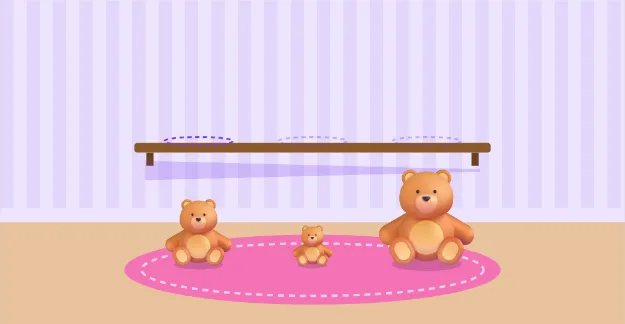
The toys are all mixed up on the rug! Can you put them on the shelf, starting with the biggest one?
Ages 3–5 · about 5 minutes · builds on What Comes Next? Color Patterns · leads to Robot Steps to the Apple, Sorting Animals by Swapping
Try this
- Find the biggest toy on the rug. Drag it up to the shelf, or just tap it.
- Now find the biggest one that is left, and put it next.
- Keep going until the smallest one is last. Watch them bounce: big, smaller, smallest!
- Not sure which is biggest? Press Show me and it will jump.
How it works
Putting things in order means lining them up by a rule, here from biggest to smallest. To do it, we compare: is this one bigger than that one? Young children often start by comparing just two things. Lining up three or four in order, which teachers call seriation, is a big step in thinking.
The trick the game teaches is simple and powerful: look at everything that is left and pick the biggest. Put it in the next spot. Then do the same again with the toys that are left. If you pick one that is not the biggest, the game gently sends it back, because there is still a bigger one waiting on the rug.
Computers sort things all the time, and one of the first ways programmers learn is exactly this one. It is called selection sort: select the biggest (or smallest) thing that is left, move it into place, and repeat. Your child is following a real sorting recipe with their own fingers, one toy at a time.
Where engineers use this
Shopping sites sort products by price, music apps sort songs by name, and phones sort photos by date. Every one of those uses a sorting algorithm, a recipe a computer follows to put things in order.
Words to know
- Biggest
- The one that is larger than all the others.
- In order
- Lined up following a rule, like from biggest to smallest.
- Sort
- Put things in order, or into groups, by following a rule.
Talk about it
Goal: Put objects in order from biggest to smallest, the first idea behind sorting.
- How did you know which toy was the biggest?
- Can we line up our shoes from biggest to smallest?
- What if we wanted smallest to biggest instead? Which one would go first?
Without a screen: Gather 4 or 5 cups, spoons or stuffed animals of different sizes. Ask your child to find the biggest and put it at one end, then the biggest of what is left, and so on. Then mix them up and try smallest to biggest, or sort family members by height.
Curriculum links: Common Core Kindergarten K.MD.A.2 (directly compare two objects with a measurable attribute) extended to ordering several objects; an early foundation for CSTA 1A-AP-08 (following step-by-step algorithms).
Questions
What is seriation in preschool?
Seriation is arranging objects in order by a quality like size, length or loudness. It usually develops between ages 3 and 6 and is an important early math and reasoning skill.
How do I teach my child to order by size?
Start with just three objects that are very different in size, and use the words big, bigger, biggest. As they get confident, use more objects that are closer in size, and try the opposite order too.
How is ordering by size related to coding?
Computers sort lists all the time using step-by-step recipes called sorting algorithms. Picking the biggest item left and moving it into place is a real one, called selection sort.