Robot Steps to the Apple
About this lesson, for parents and teachers
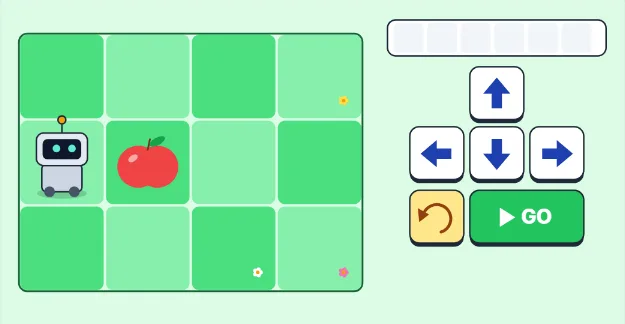
Bip the robot is hungry, but Bip only moves when you tell it which way to go. Can you give Bip the right steps to reach the apple?
Ages 3–5 · about 6 minutes · builds on Big to Small: Putting Things in Order · leads to Find the Way Through the Maze, Algorithms Are Recipes
Try this
- Tap an arrow. It goes into the white strip: that is Bip's list of steps.
- Press the green GO button. Bip does each step in order.
- If Bip bumps a rock or misses the apple, try a new list. The yellow back button takes away your last step.
- Each garden needs more steps: one, then two, then three, then four.
How it works
A robot cannot guess what you want. It needs instructions: small, clear steps like go right, go up. When you tap arrows, you are making a list of steps for Bip. When you press GO, Bip follows the list from the first step to the last, one at a time, in exactly that order. That list is a tiny computer program.
Order matters. Going up and then right can end in a different place than right and then up, especially when a rock is in the way. If Bip bumps into something, nothing is broken. We just look again, change the steps, and try once more. Trying, looking and fixing is how all programmers work.
Planning steps before you press GO is a big idea for a small child. They have to imagine Bip moving in their head, square by square. Grown-ups call a list of steps that solves a problem an algorithm. The little dots on the grass show where your plan will take Bip, so children can check their thinking before they run it.
Where engineers use this
Warehouse robots, robot vacuums and even Mars rovers follow lists of movement instructions written by people. Engineers plan the steps, test them, and fix them when the robot bumps into something.
Words to know
- Instruction
- One small step that tells someone, or a robot, exactly what to do.
- Program
- A list of instructions that a computer or robot follows in order.
- Algorithm
- A list of steps that solves a problem.
Talk about it
Goal: Give a robot a short list of arrow steps to reach the apple.
- What would happen if we pressed GO before adding any arrows?
- How many steps did Bip need? Can you count them in the strip?
- Can you give me step-by-step instructions to walk to the kitchen?
Without a screen: Make a 3 by 3 grid on the floor with tape or sticky notes, and put a toy apple in one square. One person is the robot and only moves one square for each arrow card. Your child lays out paper arrow cards first, then the robot follows them. Swap roles.
Curriculum links: Early foundation for CSTA 1A-AP-08 (model processes by creating and following algorithms) and 1A-AP-10 (programs with sequences); fits pre-K computational thinking goals in many early-learning frameworks.
Questions
Can preschoolers learn coding?
Yes, in a playful way. Children aged 3 to 5 can learn the ideas behind coding, like giving steps in order and fixing mistakes, through arrow games, floor robots and unplugged play, without any reading or typing.
What is a good first coding game for a 4 year old?
Look for games with big arrows, a clear goal like reaching an apple, and a GO button so the child plans first and then watches. Short challenges that grow from one step to a few steps work well.
Is screen-free coding better for toddlers?
Both help, and they work best together. Moving their own body on a floor grid makes directions concrete, and a game like this one lets them practice planning and fixing steps with instant feedback.