Shape Sorting Bins
About this lesson, for parents and teachers
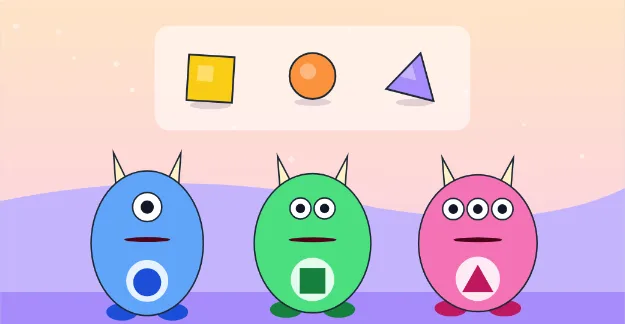
Three hungry monsters live here, and each one eats only one kind of shape. Look at their tummies and feed them the right shapes!
Ages 3–5 · about 5 minutes · builds on Spot the Odd One Out · leads to Teach the Robot: Apple or Banana?, Guess the Animal in Yes/No Questions
Try this
- Look at each monster's tummy: a circle, a square or a triangle.
- Drag a shape to the monster that eats it. Or tap the shape, then tap the monster.
- If a monster says yuck, find the monster with that shape on its tummy.
- In the last round the colors are tricky. Look at the shape, not the color!
How it works
Sorting into groups means putting things that are the same kind together. Here the rule is the shape: every circle goes to the circle monster, every square to the square monster and every triangle to the triangle monster. A shape is still a circle if it is big or small, red or yellow, and a triangle is still a triangle when it is tilted.
The tricky round paints shapes in the color of a different monster, so a pink square might want to go to the pink triangle monster. That is on purpose. It helps children notice that we are sorting by one feature, the shape, and ignoring the others. Choosing the right feature to sort by is a big step in thinking.
Computers sort things into groups all the time. Grown-ups call it classification. An email program sorts mail into inbox or spam, and a photo app groups pictures of dogs, cats and beaches. To do it, the computer looks at features and follows a rule, just like the monsters only check the shape.
Where engineers use this
Email apps classify messages as spam or not spam, and recycling plants use cameras and computers to sort plastic, paper and metal onto different belts.
Words to know
- Circle, square, triangle
- A circle is round, a square has four equal sides, a triangle has three sides and three corners.
- Sort
- Put things into groups that belong together.
- Group
- Things that are the same kind, kept together.
Talk about it
Goal: Sort circles, squares and triangles into the right bins, the start of classification.
- How do you know this is a triangle? How many corners does it have?
- Is a big circle still a circle? Is a red square still a square?
- What could we sort our toys by: color, size or kind?
Without a screen: Cut circles, squares and triangles from cereal boxes in different sizes and colors. Draw one shape on each of three bowls or paper plates and let your child sort the pieces. Then sort the same pieces again by color, and talk about how the groups changed.
Curriculum links: Common Core Kindergarten K.G.A.2 (name shapes regardless of orientation or size) and K.MD.B.3 (classify objects into categories); an early foundation for classification ideas in the AI4K12 framework.
Questions
What shapes should a 3 year old know?
Many 3-year-olds start with circles, squares and triangles, then learn rectangles, ovals and stars. Naming shapes in different sizes and turned different ways helps them understand what makes a shape that shape.
Why are shape sorters good for toddlers?
Sorting by shape builds careful looking, matching and early classification, the skill of grouping things by a rule. It also builds hand control when children drag or place pieces.
How is sorting shapes related to computers and AI?
Computers classify things, like spam emails or photos of cats, by looking at features and following rules. Sorting shapes by one feature while ignoring color is the same idea at a toddler scale.