Teach the Robot: Apple or Banana?
About this lesson, for parents and teachers
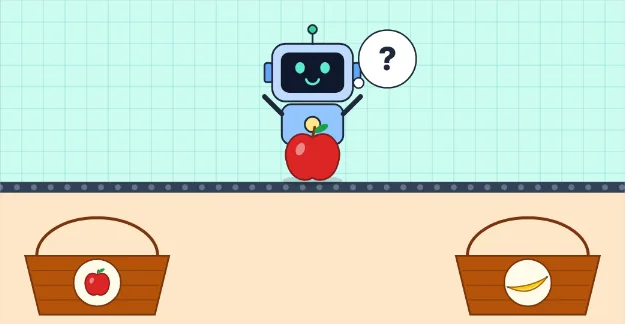
Bip the robot has never seen fruit before! Can you teach Bip which ones are apples and which ones are bananas?
Ages 3–5 · about 6 minutes · builds on Shape Sorting Bins · leads to How AI Learns From Examples
Try this
- Watch a fruit ride in on the belt. Bip shows its guess in a bubble, or a question mark if it does not know.
- Put the fruit in the right basket: the apple basket or the banana basket.
- Each fruit you sort goes into Bip's memory, the row of little circles. A dotted line shows which one Bip thinks it looks like.
- Keep teaching until Bip gets three right in a row and earns three stars.
How it works
At the start, Bip knows nothing. It cannot tell an apple from a banana, so the first guess is a question mark, and the next guesses are often wrong. Bip does not get rules from us. Instead, it learns from examples: every time you put a fruit in the right basket, Bip remembers what that fruit looked like and which basket it went in.
Bip looks at two things on each fruit: how long it is and what color it is. When a new fruit comes, Bip finds the example in its memory that is most alike, and guesses the same name. That is a real AI method called nearest neighbor. Green apples and yellow apples are tricky at first, because a yellow apple is the same color as a banana. With more examples, shape wins.
This is the very first idea of artificial intelligence: a computer can get better at a job by learning from lots of examples, instead of being told every rule. The examples have to be right, too. If a teacher put bananas in the apple basket, Bip would learn the wrong thing. That is why the game asks you to look again before Bip learns.
Where engineers use this
Photo apps learn to find pictures of dogs or beaches from millions of labeled examples, and supermarket scales with cameras learn to recognize fruit at the checkout.
Words to know
- Example
- One thing we show, with its right name, so someone can learn.
- Learn
- Get better at something by seeing and trying again and again.
- AI
- Short for artificial intelligence: computers that learn from examples to make good guesses.
Talk about it
Goal: Show a robot examples until it learns to tell apples from bananas: the very first idea of AI.
- Why did Bip get the first fruit wrong?
- What makes a banana different from an apple, besides color?
- What would happen if we put an apple in the banana basket? What would Bip learn?
Without a screen: Play Robot Learner: you are the robot and know nothing. Your child shows you real fruit or toys one at a time and tells you its name. After a few examples, guess the name of each new one aloud, sometimes wrongly at first, and let your child correct you. Talk about how more examples helped.
Curriculum links: AI4K12 Five Big Ideas in AI, Big Idea 3 (Learning: computers can learn from data), at a pre-K level; also supports Common Core Kindergarten K.MD.B.3 (classify objects into categories).
Questions
How do you explain AI to a preschooler?
AI is a computer that learns by looking at lots of examples, a bit like how a child learns what a dog is by seeing many dogs. You can say: we show it examples, it makes guesses, and it gets better.
Is it too early to teach AI to a 4 year old?
Not the basic idea. Young children already learn from examples every day, so a playful game where they become the teacher of a robot is a natural, gentle introduction, without screens being the main focus.
How does the robot in this game actually learn?
It measures two features of each fruit, length and color, and stores the examples you sort. For a new fruit it finds the most similar stored example and guesses that label, a real method called nearest neighbor classification.