Spot the Odd One Out
About this lesson, for parents and teachers
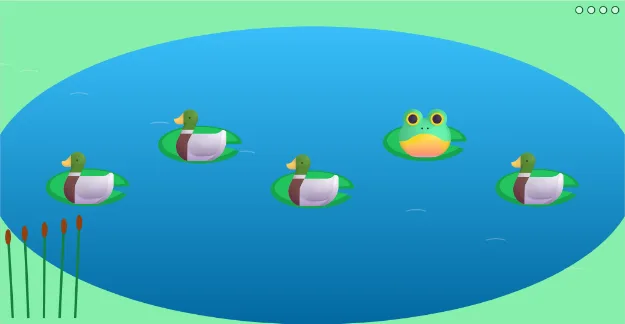
Five friends are sitting on lily pads. Four of them match, but one is a little bit different. Can you spot it?
Ages 3–5 · about 4 minutes · builds on What Comes Next? Color Patterns · leads to Shape Sorting Bins
Try this
- Look at all five friends in the pond. Which one does not match?
- Tap the one that is different. It jumps for joy when you find it!
- Each pond is trickier: a different animal, then a different color, then a different size, then a duck looking the other way.
- Need help? Press Show me and the odd one will glow.
How it works
To find the odd one out, we compare. We look at each friend and ask: is it the same as the others, or different? Things can be different in lots of ways. They can be a different kind of thing, a different color, a different size, or even point in a different direction. The game changes the way it is different every round.
The tricky part is knowing what to look at. In the first pond you look at what kind of animal it is. In the second, every friend is a fish, so you have to look at the color instead. Learning to notice one feature at a time, and to ignore the rest, is a big thinking skill for young children.
Computers do this too! Programs that check for problems, like a bank looking for a strange payment, are searching for the odd one out. Grown-ups call it spotting anomalies. And when an artificial intelligence learns to recognize things, it has to learn which differences matter and which ones do not, just like you.
Where engineers use this
Banks use computers to spot one odd payment among millions of normal ones, and factories use cameras to find the one broken cookie or bottle on a fast belt.
Words to know
- Same
- Looks or works just like the others.
- Different
- Not the same in some way, like color, size, shape or kind.
- Odd one out
- The one thing in a group that does not match the rest.
Talk about it
Goal: Find the one thing that is different from the rest.
- How was the odd one different: its color, its size or what it was?
- Can you find something in this room that is different from everything around it?
- Can you make an odd one out for me to find?
Without a screen: Set out four spoons and one fork, or four red blocks and one blue block, and ask which one does not belong. Then make it harder: five spoons with one upside down, or socks where one has a different stripe. Let your child set up a puzzle for you.
Curriculum links: Supports Common Core Kindergarten K.MD.B.3 (classify objects into categories) and early visual discrimination goals in pre-K frameworks; an early foundation for the AI4K12 idea that computers learn by noticing features.
Questions
How do odd one out games help preschoolers?
They practice careful looking and comparing, and noticing which feature is different, such as color, size or shape. These skills support early reading, math and problem solving.
At what age can a child spot the odd one out?
Many 3-year-olds can find an object that is a different kind or color. Spotting smaller differences, like size or direction, often comes a little later, around 4 to 5.
What does odd one out have to do with computers?
Computers are often asked to find the unusual item in a lot of data, such as a strange payment or a faulty part. This is called anomaly detection and it starts with comparing same and different.