What Comes Next? Color Patterns
About this lesson, for parents and teachers
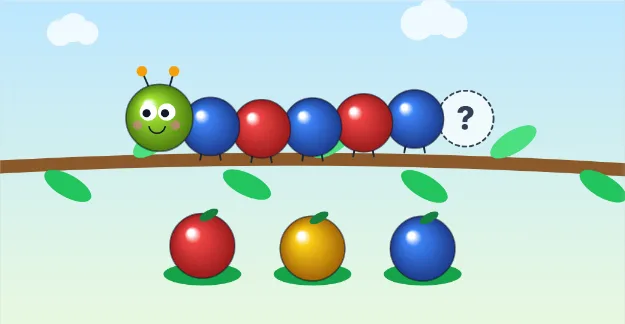
This caterpillar loves colors that go in a pattern. Red, blue, red, blue... can you guess which berry comes next?
Ages 3–5 · about 5 minutes · leads to Big to Small: Putting Things in Order, Spot the Odd One Out
Try this
- Listen to the colors on the caterpillar's body. The voice reads them out for you.
- Tap the berry you think comes next. If it fits, the caterpillar grows!
- Try the trickier ones: red, red, blue, and a pattern with three colors.
- Stuck? Press Show me and the part that repeats will glow.
How it works
A pattern is something that repeats again and again in the same order. Red, blue, red, blue is a pattern because the little piece red, blue keeps coming back. Once you find the piece that repeats, you can always say what comes next, even far into the future, without having to see it first.
The patterns in this game get a little harder each time. First two colors take turns. Then one color comes twice before the other: red, red, blue. Then three colors take turns. Grown-ups call these AB, AAB and ABC patterns. The game always works out the answer by finding the repeating piece and counting where we are in it.
Spotting patterns is one of the most important skills in computing. Programmers look for steps that repeat and write them once as a loop. And artificial intelligence works by finding patterns in lots of examples, so it can guess what comes next, like the next word you might type on a phone.
Where engineers use this
Phone keyboards guess your next word by learning patterns in what people type, and music apps spot patterns in songs you like to suggest new ones.
Words to know
- Pattern
- Things that repeat in the same order, again and again.
- Repeat
- Do or show the same thing again.
- Predict
- Make a smart guess about what will come next.
Talk about it
Goal: Spot a repeating pattern (red, blue, red, blue) and pick what comes next.
- What part of the caterpillar keeps repeating?
- Can you make a pattern with claps and stomps, like clap, stomp, clap, stomp?
- Where do you see patterns at home, on clothes, tiles or a calendar?
Without a screen: Make a pattern snake with colored socks, toy blocks or two kinds of pasta: red, blue, red, blue. Leave a gap at the end and ask your child what comes next. Then let them build a pattern for you to finish, including tricky ones like big, big, small.
Curriculum links: Supports early algebraic thinking about repeating patterns found in many pre-K frameworks (for example Head Start ELOF patterning goals); an early foundation for CSTA 1A-AP-10 ideas about repetition and loops.
Questions
What are AB patterns for preschoolers?
An AB pattern has two things that take turns, like red, blue, red, blue or clap, stomp, clap, stomp. Once children can continue AB patterns, they usually move on to AAB and ABC patterns.
Why is pattern recognition important for kids?
Noticing what repeats helps children predict, which is part of early math, reading and music. It is also the root of how programmers use loops and how AI learns from examples.
What age can kids recognize patterns?
Many children copy simple AB patterns around age 3 and can continue and create their own patterns between 4 and 5. Playing with real objects, sounds and movements helps a lot.