If It Rains, Take an Umbrella
About this lesson, for parents and teachers
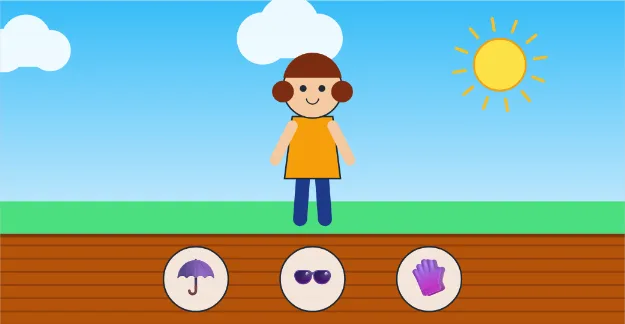
Mia wants to play outside, but first she needs the right thing for the weather. Is it raining, sunny or snowing?
Ages 3–5 · about 5 minutes · builds on Light On, Light Off
Try this
- Look outside. Is it raining, sunny or snowing?
- Tap the thing Mia needs: the umbrella, the sunglasses or the mittens.
- Each new rule goes on the board at the top: weather, arrow, thing.
- Later the weather comes back. Can you remember the rule? Peek at the board if you need to.
How it works
A rule tells us what to do when something happens. If it rains, take an umbrella. The first part, if it rains, is the thing we check. The second part, take an umbrella, is what we do when it is true. Children already use rules like this every day: if my hands are dirty, I wash them.
In the game, every time Mia learns a rule it is added to the rule board with a picture: rain, arrow, umbrella. The arrow means then. When the same weather comes back, the same rule gives the same answer. That is what makes a rule useful: you can use it again and again without working it out from the start.
Computers are full of if-then rules. Programmers write them like if raining then show umbrella. A weather app follows rules like this to pick the little picture you see, and a game uses them to decide what happens when you press a button. A child who can match weather to clothes is practicing the same kind of thinking.
Where engineers use this
Weather apps use if-then rules to choose icons and send alerts, like if rain is likely then notify the user. Smart homes use them too: if the room is dark, then turn on the light.
Words to know
- If
- The thing we check first, like if it is raining.
- Then
- What we do when the if part is true, like then take an umbrella.
- Rule
- An if-then that always gives the same answer for the same thing.
Talk about it
Goal: Match each kind of weather to what we need, learning simple if-this-then-that rules.
- What do you need if it is cold outside?
- Can you make up an if-then rule for bedtime?
- What rules does our family follow, like if the light is red, then we stop?
Without a screen: Draw three weather cards (rain, sun, snow) and collect a real umbrella, sunglasses and mittens or a hat. Hold up a card and let your child grab the matching item. Then flip roles, and invent silly new rules together, like if I clap, then you hop.
Curriculum links: Early foundation for CSTA 1B-AP-10 (programs that include conditionals) and 1A-AP-08 (following algorithms); also supports Next Generation Science Standards K-ESS2-1 (observe local weather) and K-ESS3-2 (preparing for weather).
Questions
How do you explain if-then to a preschooler?
Use everyday rules: if it rains, then we take an umbrella; if the light is red, then we stop. Say the if part, pause, and let your child finish the then part.
What is cause and effect for toddlers?
Cause and effect means one thing makes another thing happen, like rain making us wet. Toddlers learn it by trying things, and if-then rules turn those lessons into something they can remember and use.
Why are if-then rules important in coding?
Programs make decisions with if-then statements, called conditionals. They let a computer do different things in different situations, which is how apps, games and robots respond to the world.