How the Internet Sends Messages
About this lesson, for parents and teachers
When you send a message, it does not travel in one piece. It is chopped into little numbered packets that each find their own way. Send one and see the chaos, then fix it.
Ages 9–11 · about 8 minutes · builds on Shortest Path on a Map
Try this
- Press Send. Watch your message get split into numbered packets that take different routes.
- The packets arrive mixed up. Tap them in order, #1 first, to rebuild the message.
- Break a router by tapping it, then send again. Do the packets still get through?
- When a packet gets lost, find which number is missing and ask for it again.
How it works
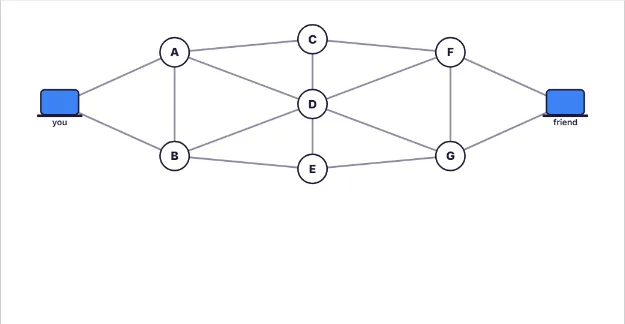
The internet is a giant web of computers called routers, connected by cables and radio links. There is no single wire from you to your friend. Instead, your message hops from router to router until it reaches them. A message to someone in another country might pass through 10 or 20 routers in less than a second. Nobody plans the whole trip in advance; each router only decides the next hop.
Big messages are cut into small pieces called packets. Each packet carries a little bit of the message, the address it is going to, and a sequence number like #2/4 (piece 2 of 4). Every router looks at the address and passes the packet along a link that leads closer to it.
Packets from the same message can take different routes. Some roads are busy, so a packet may wait in a router's queue. That is why packets often arrive out of order. The receiving computer uses the sequence numbers to put them back together correctly. Nobody can see the whole internet at once, so each packet just follows the best road it knows about at that moment.
If a router breaks, packets simply go around it. That makes the internet very hard to break. And if a packet gets lost, the receiver notices a number is missing (it has #1, #2, #4 but no #3) and asks the sender to send that one again. This is what a protocol called TCP does for nearly everything you do online.
Where engineers use this
Every web page, video call and game you play online travels as packets. Networking engineers design routers and protocols like TCP/IP so that billions of packets a second find their way even when cables are cut.
Words to know
- Packet
- A small piece of a message, with an address and a number, sent across a network.
- Router
- A computer that receives packets and forwards each one towards its destination.
- Sequence number
- The number on a packet that says where it belongs in the message, like #3 of 5.
- Protocol
- A set of rules computers follow to talk to each other, like TCP and IP.
Talk about it
Goal: Split a message into packets, watch them take different routes, and put them back in order.
- Why do you think the internet splits messages into small packets instead of sending one big piece?
- What would happen to the message if the packets had no numbers?
- How is this like sending a long letter as several numbered postcards?
Without a screen: Write a sentence on paper, cut it into numbered strips of three letters, and hand them to different family members who walk to another room by different routes. The receiver puts the strips in order. Secretly keep one strip back and see if the receiver can name the missing number.
Curriculum links: CSTA K-12 1B-NI-04 (model how information is broken down into smaller pieces, transmitted as packets through multiple devices over networks and the internet, and reassembled at the destination); AP Computer Science Principles CSN-1 (the internet)
Questions
How does the internet work in simple words?
The internet is millions of connected routers. Your message is split into numbered packets, each router passes them along towards the address, and the receiving computer puts them back in order.
What are packets on the internet?
Packets are small chunks of data. Each one carries part of a message plus information like where it is going and its number in the sequence, so it can be reassembled at the other end.
What happens if a packet gets lost?
The receiving computer notices a missing sequence number and asks for that packet again. This is handled by a protocol called TCP, so you usually never notice.